

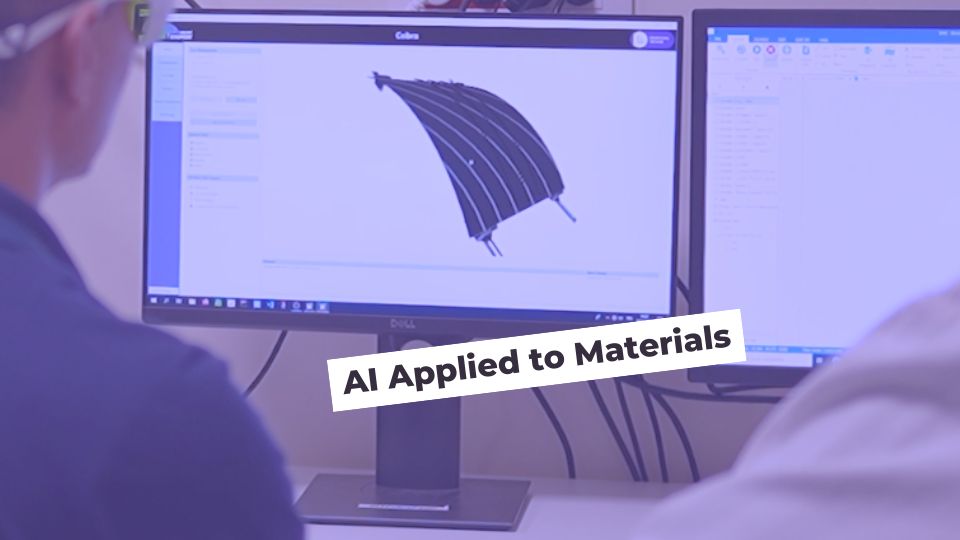
Artificial Intelligence (AI) applied to materials is a strategic activity at IRT Saint Exupéry, standing at the crossroads of our “Intelligent Technologies” and “Advanced Manufacturing Technologies” pillars.
Our ambition? To provide comprehensive mastery of an industrial part’s lifecycle from design and manufacturing to quality analysis to accelerate innovation in critical environments such as aeronautics and space.
The key to our success lies in the synergy between our robust expertise in materials science and AI for critical systems and services. This collaboration is driven by the emergence of profiles with dual skill sets, ensuring seamless transversality between the physical and digital worlds.
AI at Every Stage: Design, Manufacturing, and Analysis
IRT has achieved numerous milestones illustrating AI’s transformative potential across the entire materials value chain.
AI reveals immense potential right from the design phase. It allows us to inform fundamental choices materials, geometry, and manufacturing parameters to precisely achieve desired properties.
We develop approaches combining Machine Learning (ML) and physical models to efficiently explore design spaces and identify robust process windows. The WALLSAPP project is a prime example: using physics-guided models helped optimize laser parameters in a metal additive manufacturing process to reach the target material thickness.
Without AI, this optimization traditionally relies on long and costly iterative experimental campaigns based on successive designs of experiments and empirical adjustments. Integrating ML techniques allowed us to identify optimal parameters with only two test campaigns. Furthermore, compared to purely data-driven approaches, the ML + Physics tandem led to a 20% reduction in thickness prediction error.
These methods thus predict a part’s final properties and drastically reduce the number of experimental tests required for qualification. Coupling physical models with ML not only improves prediction quality but also significantly accelerates development cycles a key asset for the industry.
In the manufacturing phase, AI plays a central role in ensuring smooth process flow and detecting deviations in real-time. Advanced manufacturing processes generate a massive volume of heterogeneous data, which is difficult to exploit using traditional analysis methods or purely human supervision. By directly leveraging sensor data, AI enables immediate decision-making, alerting experts without waiting for post-production analysis.
Our monitoring work covers a wide spectrum: additive manufacturing (DED, L-PBF, EBM), laser processes, and hybrid processes (forging, welding, surface treatments), among others. In the COBRA project, we controlled the working distance during a laser surface treatment before bonding via intelligent analysis of the generated plasma. We can now automatically distinguish nominal conditions from degraded situations, ensuring treatment quality.
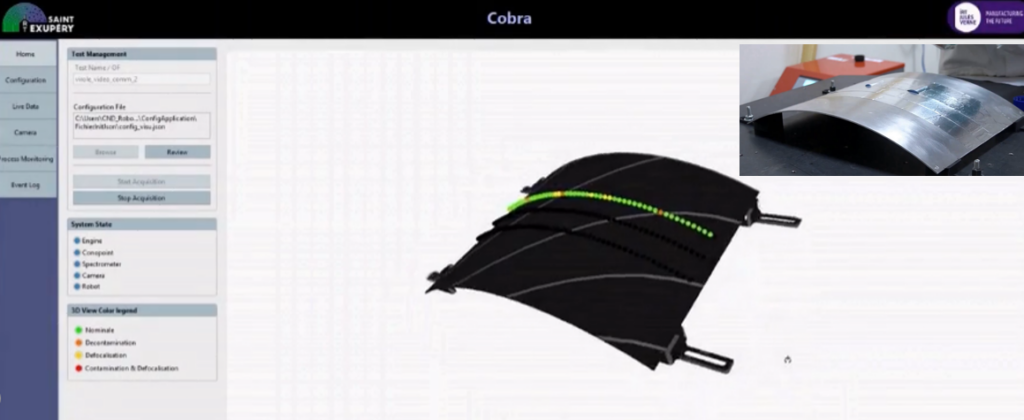
In situ analysis of laser surface treatment, featuring process anomaly detection.
Finally, AI intervenes during part analysis, the ultimate step to guarantee compliance and integration into critical systems.
We apply algorithms to data from destructive and non-destructive testing (NDT) to evaluate material properties (mechanical, thermal, etc.) and material health, meeting our industrial partners’ requirements.
To this end, IRT Saint Exupéry develops computer vision tools capable of automatically processing tomography volumes. These systems locate defects, qualify their typology (porosity, cracks, etc.), and provide material experts with quantitative metrics for decision support.
The tomographIA library, developed internally at IRT Saint Exupéry, illustrates this approach. Integrated into a streamlined decision chain, it relies on Explainable AI (XAI) models, adapted for both metallic and composite materials. The goal is twofold: to make non-destructive testing more reliable and to drastically reduce analysis times.
The analysis of a tomographic volume, which typically requires several hours of human expertise, can now be completed in a few minutes by the machine. This automation accelerates data processing and reduces human errors related to fatigue or the complexity of defects. It frees up expert time for high-value-added analysis while improving the robustness and traceability of decisions.
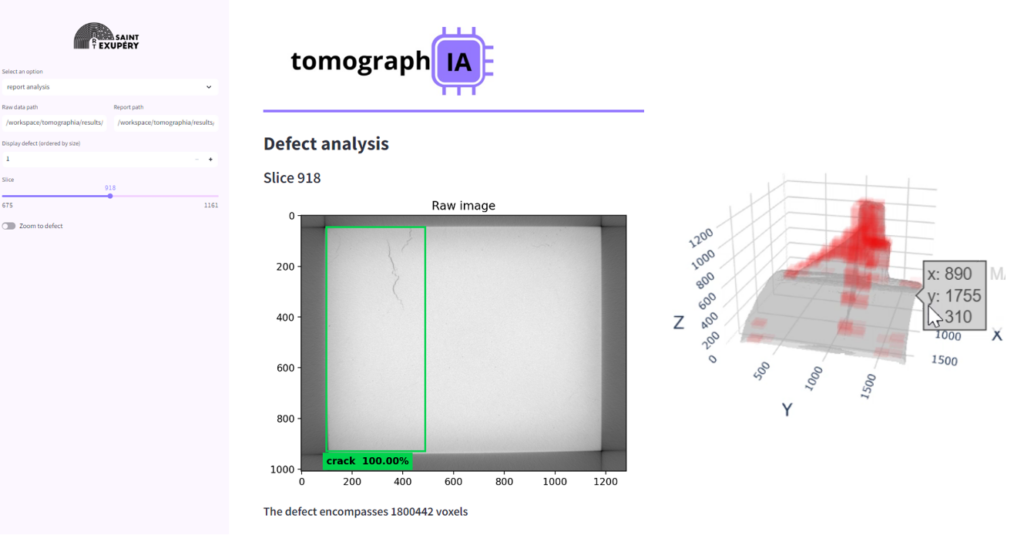
Visual interface of tomographIA and visualization of a part following automated defect analysis.
Meeting Industrial Challenges
Integrating AI into critical environments raises major challenges:
- Data quality and availability.
- Data traceability and compliance.
- Certifications and standards dedicated to AI systems, including “black box” models.
IRT Saint Exupéry addresses these issues by offering its partners data-centric approaches covering the entire development chain. The key to our success lies in working closely with material experts, combining their knowledge with explainable AI models they can understand and trust.
Augmenting Human Expertise through AI
At IRT Saint Exupéry, we advocate for a vision where AI augments human expertise. By merging experimental data, physical knowledge, and learning algorithms, AI with the “human-in-the-loop” becomes a powerful lever to:
- Better understand material behavior.
- Optimize manufacturing processes.
- Guarantee part compliance and traceability.
- Facilitate expert decision-making.
This vision is embodied by the development of robust and explainable models, compatible with the certification requirements essential for critical systems. Through this mastered hybrid approach, IRT Saint Exupéry stands as a key partner in accelerating the entry of materials engineering into the digital era.