

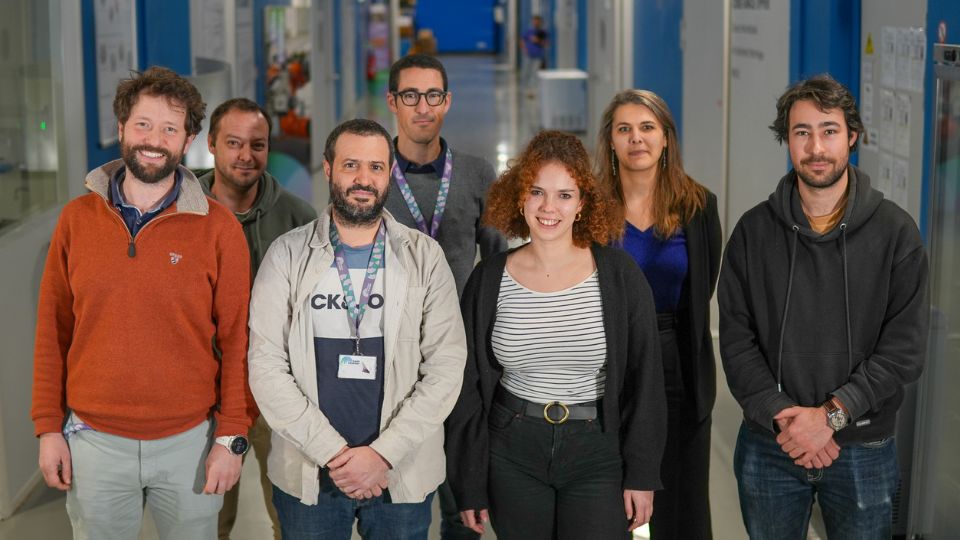
Ice accretion on exposed aircraft surfaces poses a major risk to flight safety, reduces aerodynamic performance, and increases energy consumption. Current de-icing systems, while effective, are penalizing in terms of weight, integration complexity, and energy requirements. The FREEzING 2 project, led by IRT Saint Exupéry, aims to cross a technological threshold by exploring new passive and hybrid strategies that combine functional coatings with low-consumption active de-icing systems.
A Strategic Collaboration
The FREEzING 2 project relies on a collaboration between leading academic partners (ICA UMR CNRS 5312 / University of Toulouse / INSA Toulouse / ISAE-SUPAERO / IRCER) and industrial players (Airbus, Safran, Liebherr, Specific Polymers). This synergy makes it possible to address icing challenges from the formulation of icephobic coatings and their combination with low-consumption active systems, through to performance evaluation in icing wind tunnels.
Passive and Hybrid Strategies to Combat Ice
The project explores two major complementary approaches:
- The Passive Strategy: Based solely on the use of functional coatings (paints and sol-gels) capable of limiting ice adhesion or even delaying its formation.
- The Hybrid Strategy: Combines these coatings with low-consumption active de-icing systems, specifically electrothermal and electromechanical versions.
The objective is to significantly reduce the energy required for de-icing while maintaining a high level of efficiency. This hybridization paves the way for both anti-icing (preventing ice formation) and de-icing (facilitating its detachment) functions, with a direct impact on onboard weight and the energy consumption required to operate the protection system.
Testing and Performance Evaluation
To evaluate the performance of the developed solutions, the project teams utilize the icing wind tunnel at INSA Toulouse / ISAE-SUPAERO, located at the Institut Clément Ader (ICA). Representative aeronautical components, notably wing leading edges (NACA profiles), are coated or functionalized and then tested under representative conditions.
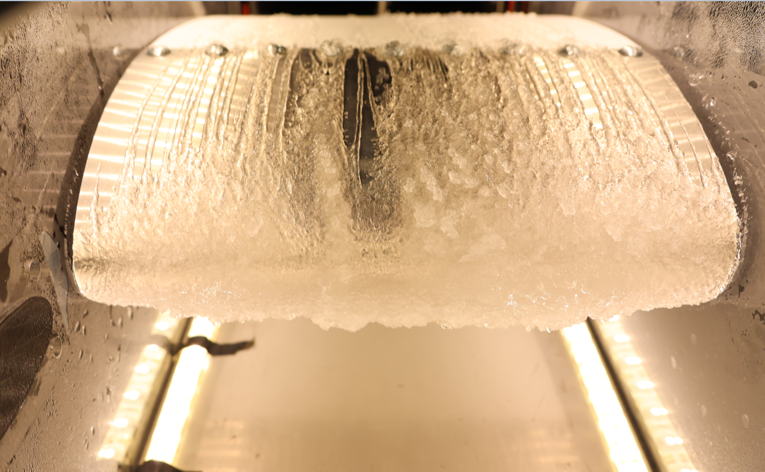
Testing in the icing wind tunnel at ICA UMR CNRS 5312 / INSA Toulouse / ISAE-SUPAERO.
During these tests, both the material alone and the complete de-icing system are evaluated, including:
- Raw and coated surfaces in passive configurations.
- Hybrid configurations combining functional surfaces and active systems, coupled with onboard instrumentation for precise performance monitoring.
These tests are conducted under various icing conditions to characterize ice formation, adhesion, and shedding depending on the type of ice (e.g., rime or glaze ice).
Promising Results and Future Outlook
Initial results confirm the potential of coatings to facilitate ice shedding and even limit its formation. In the hybrid strategy, the combination with thermal de-icing reduces the required power, opening the door to more energy-efficient architectures.
Ultimately, these solutions could lead to:
- A reduction in the weight of ice protection systems.
- Lower energy consumption.
- An overall improvement in aircraft performance and environmental footprint.